
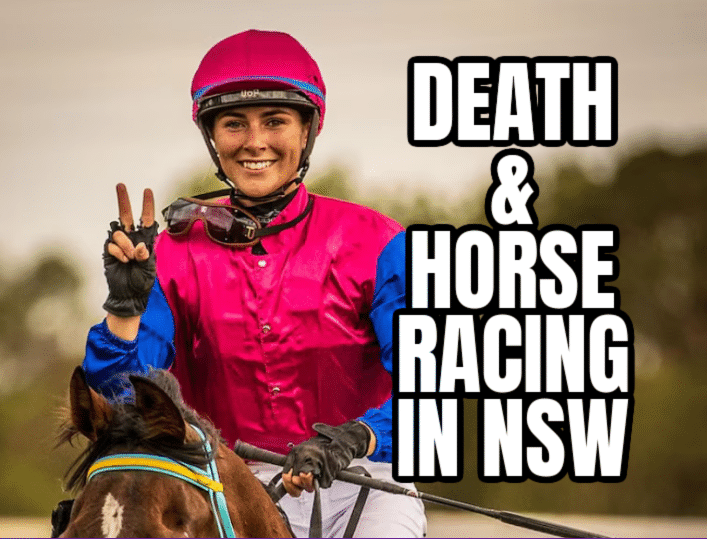
TWO HORSES. ONE YOUNG JOCKEY. QUESTIONS FOR NSW RACING.
November 2026 | New South Wales, Australia
Two horses and a 22-year-old apprentice jockey have died in New South Wales racing incidents — that we know of — so far this November.
Their deaths are tragic. But beyond the condolences, tributes and expressions of grief, there are questions about the horses, their physical condition, their workloads and the risks inherent in an industry that continues to put horses and jockeys in harm’s way.
And those questions deserve answers.

SCOISH MALOISH: JUST 3 YEARS OLD
On November 5, 2026, Scoish Maloish died at Gosford.
He was just three years old.
His racing record, highlighted in the accompanying video, shows that he had already been raced or trialled 13 times.
Thirteen times.
At an age when a horse is still physically developing, we have to ask why there are no restrictions that adequately protect young horses from excessive racing and training demands.
A young horse’s body is not an inexhaustible resource. Every stride at speed places forces on bones, joints, tendons and other soft tissues.
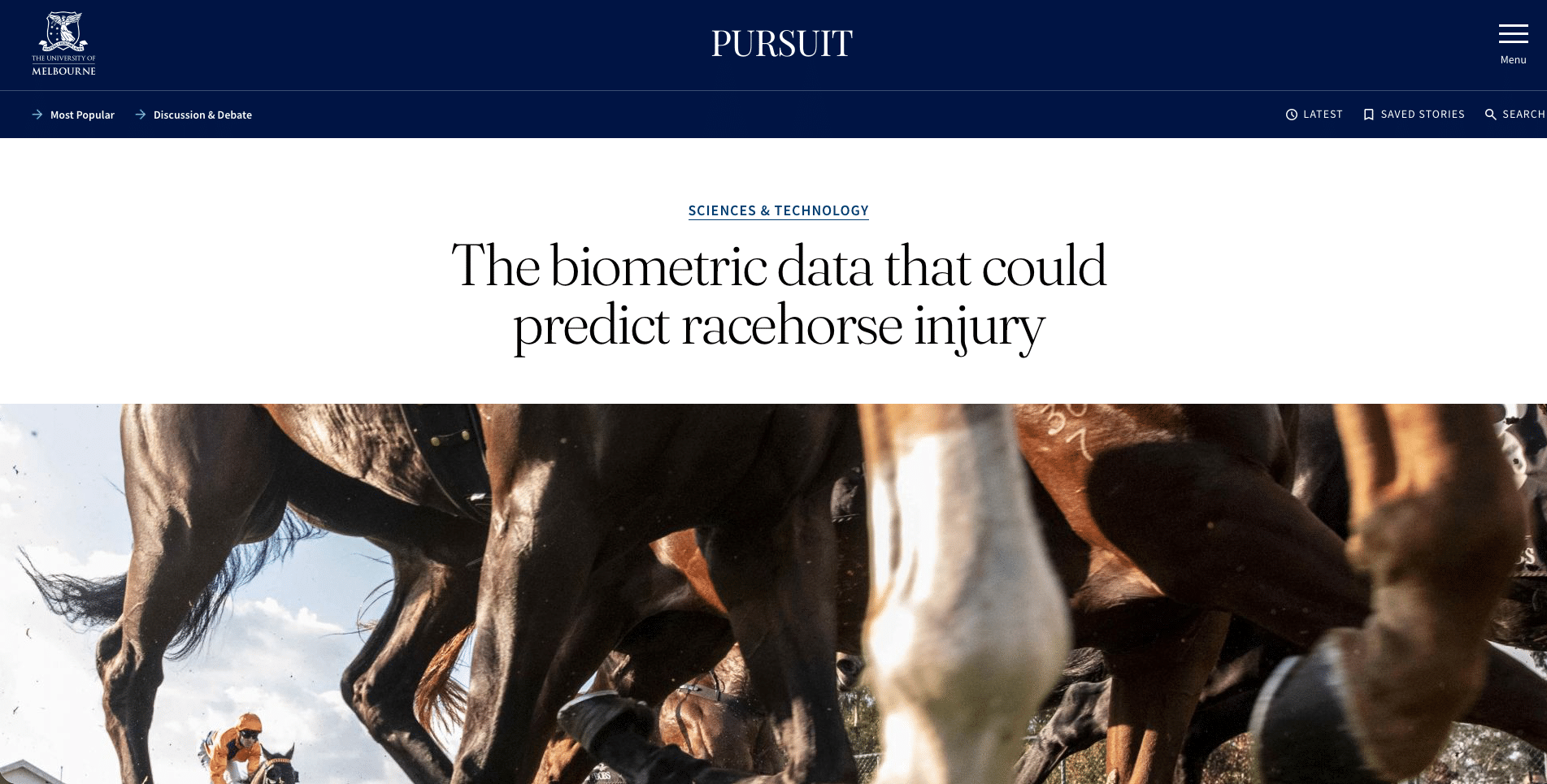
The video highlights the work of Professor Chris Whitton, who has explained that bone and soft tissue can only withstand a finite number of individual loads, or strides, at high speed before damage develops. [Learn more here.]
So why are we allowing developing horses to be subjected to repeated physical demands without meaningful safeguards?
And how many more young horses AND JOCKEYS must die before this becomes a serious priority?
MARNOO & THE DEATH OF JOCKEY IZZY NEALE
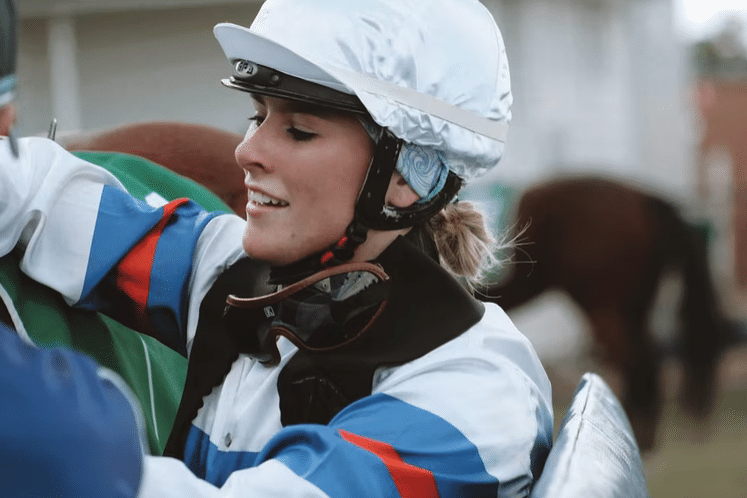
Photo of Izzy Neal, 22 from Instagram
Just days later, another tragedy unfolded at Warren.
Marnoo suffered a catastrophic musculoskeletal injury after falling while rounding the home turn. Following examination by the Veterinary Officer, the horse was euthanised.
Riding Marnoo was 22-year-old apprentice jockey Izzy Neale.
Izzy subsequently died from the injuries she sustained in the fall. Her death was confirmed on November 10.
There is no question that the loss of a young life is devastating.
But Marnoo’s death also demands scrutiny.
Was Marnoo sound? Were there underlying injuries? What does his racing history tell us about the demands placed on him?
The video draws attention to his racing record, describing it as characterised by long spells and numerous shorter breaks.
Those breaks raise another important question: were they simply part of his racing schedule, or did they reflect physical problems and the need for recovery?
A racing record alone cannot establish whether a horse was injured or unsound. That requires proper veterinary investigation. But it is precisely why those records, veterinary examinations and injury histories matter.
THE PROBLEM OF OVER-RACING & INADEQUATE RECOVERY
One of the concerns raised in the video is the relationship between over-racing, inadequate recovery time and catastrophic limb injuries.
The video also identifies another potential risk factor: a horse returning to racing after a lengthy spell following a serious injury.
These are important issues that should be investigated.
Horses cannot tell us when their bodies are approaching their physical limits.
They cannot refuse a race because they are not fully recovered.
They cannot make decisions about their own training schedules or racing careers.
Those decisions are made for them.
And when the consequences are catastrophic, it is the horse (AND IN SOME CASES THE JOCKEY) who pays the ultimate price.
WHAT HAPPENS BEFORE A CATASTROPHIC BREAKDOWN?
The video cites veterinary research indicating that necropsies of racehorses can reveal pre-existing pathology, including stress fractures, in 80–90% of cases involving catastrophic breakdowns.
This is an alarming figure.
It raises an important question about how injuries are identified, monitored and managed before horses return to racing.
A catastrophic breakdown may appear sudden, but the underlying damage may have been developing long before the horse fell.

The video also references the 2026 coronial inquest into the death of apprentice jockey Marina Morel, (ABOVE) which found pre-existing pathology in the horse Lina’s Choice. [LEARN MORE HERE.]
ARE FINANCIAL INCENTIVES TAKING PRIORITY OVER SAFETY?
Ultimately, we have to ask a much bigger question.
Are financial incentives contributing to decisions that put horses and jockeys at unnecessary risk?
Horse racing is a commercial industry. There are owners, trainers, breeders, wagering interests, prize money and considerable financial pressures.
But where does the welfare of the horse fit into those decisions?
How much racing is too much? How much recovery time is enough? What happens when a horse has suffered a serious injury? And who is accountable when the warning signs are missed?
These are not unreasonable questions. They are fundamental questions about the responsibilities of an industry that depends entirely on horses.
CONDOLENCES ARE NOT ENOUGH
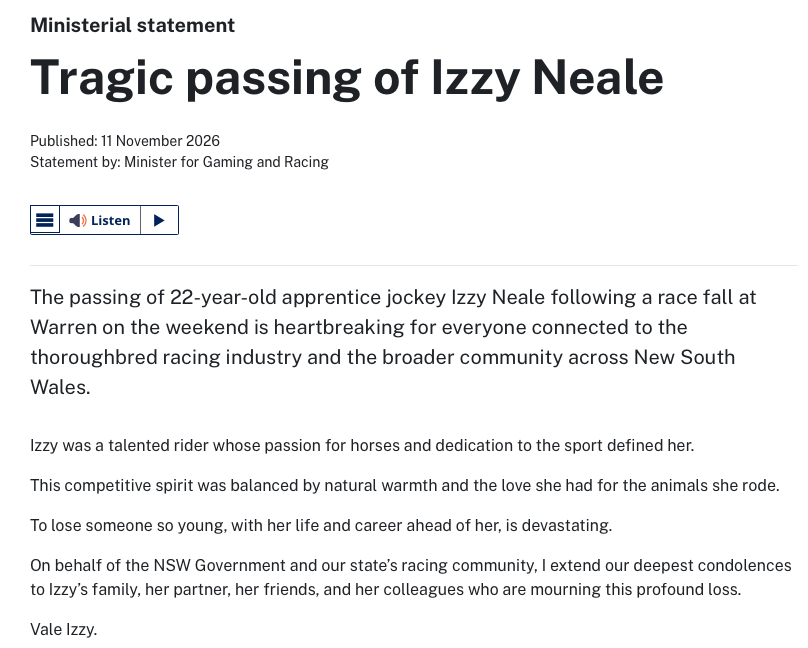
We extend our condolences to Izzy Neale’s family, friends and everyone affected by these tragedies.
But condolences cannot be the end of the conversation.
Two MORE horses involved in the racing industry have died. Another young jockey has died. And there are legitimate questions about workloads, veterinary oversight, injury management and the systems intended to protect those involved.
We cannot continue to treat each death as an isolated tragedy without examining the broader circumstances.
If racing authorities are genuinely committed to horse welfare and jockey safety, they must be prepared to answer the difficult questions — transparently, independently and publicly.
Horses cannot ask these questions themselves – but we can.
What do YOU think?
Join the conversation on our Facebook page at: https://www.facebook.com/@NoAussieHorseSlaughter
#MOHM THREATENED?
We’ve been threatened by those in the horse racing industry and those who benefit from horse slaughter more times than we can count.
But we are not going away.
We are going to persist until horse slaughter no longer exists for any purpose within Australia -- and until the horse racing industry makes drastic changes.
We are going to continue our hands-on work to offer lifelong sanctuary to as many horses as possible. We generally have 19 at just one of our locations.
We have the acreage to take on more horses as financial support allows.


CURRENT PETITIONS
WE TAKE SOME PETITIONS SERIOUSLYAt Meet Our Horse Meat, we take 'some' petitions seriously—because we know not all petitions are created equal. That’s why we generally do not promote petitions that are privately hosted or lack government backing. Instead, we focus on...
BRUMBY SPECIFIC WEBSITE
#MOHM HAS A BRUMBY SPECIFIC WEBSITE TOOAs you know we are dedicated to banning the slaughter of horses in Australia for any purpose and that includes wild horses. Please join us on our "sister" website dedicated to banning the slaughter of wild horses AKA Brumbies for...
RACEHORSES SHOT FOR MEAT VICTORIA AUSTRALIA
WE NEED YOUR HELP TO DEMAND INVESTIGATION INTO PETER LOFFEL You will NOT see the footage of horses being shot anywhere on this page. If you wish to watch it, you will need to click through to Farm Transparency Project's original investigation using the link provided...

Join us on social media and become a keyboard warrior.