
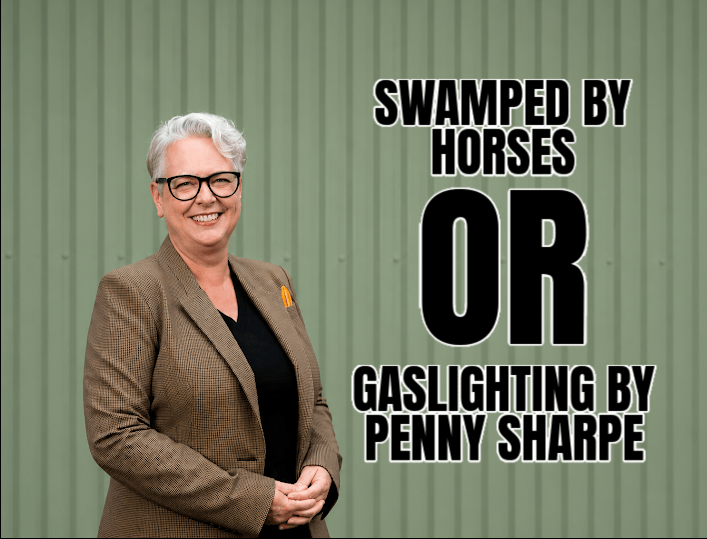
SWAMPED BY HORSES OR IS PENNY SHARPE
GASLIGHTING?
Is Penny Sharpe MLC using aerial slaughter of horses as a political strategy?
Our opinion piece argues that the NSW Government’s aerial shooting of Brumbies has become far more than a wildlife management program. We contend it has evolved into a highly publicised political issue that projects environmental leadership while diverting attention from broader environmental failures. This article examines whether the Brumby massacre has become a form of political theatre.
Has the NSW Government deliberately elevated the issue to generate headlines, create division, and reinforce environmental credentials while more significant environmental challenges continue largely unresolved?
Has Penny Sharpe engineered division with the knowledge that shooting horses in such an inhumane way will provoke outrage and endless publicity?
Do politicians deliberately undermine social cohesion as political strategy?
Central to this issue is that native animals are endangered by a horde of horses. Although the numbers of wild horses are contested, the proponents of shooting have created a moral panic by presenting the issue as a simple choice between protecting native wildlife or protecting wild horses.
The Department of Climate Change, Energy, the Environment and Water has defended the aerial shooting of wild horses in Kosciuszko National Park as essential for protecting threatened species and fragile ecosystems.
Opponents, however, argue that the policy has become symbolic politics rather than sound conservation. We question whether the intense focus on Brumbies has overshadowed broader environmental concerns that arguably pose a much greater risk to native wildlife.
Has the government benefited from a highly emotive issue that dominates public discussion while other environmental policies attract relatively little scrutiny? Has the Brumby massacre become a calculated political distraction?
The debate extends well beyond wild horse management. We ask whether the government has fostered an unnecessary divide between Brumby advocates and environmental advocates, encouraging the public to believe they must choose between protecting wild horses or protecting native wildlife.
Many Australians reject that binary entirely. We argue it is entirely possible to care deeply about both.
These questions have become increasingly relevant as the March 2027 NSW State Election approaches. What may initially have generated political capital is increasingly becoming a political burden.
The public is no longer hearing only the language of “aerial culling”; they are seeing what it means. Terrified horses are chased by helicopters and shot from the air. Because both the helicopter and the horse are moving, death is never instantaneous. Multiple shots are required, meaning horses endure fear, pain and prolonged suffering before they die.
There is nothing humane about this. As footage and eyewitness accounts continue to emerge in Australia and overseas, the policy has become increasingly difficult to defend and has attracted growing criticism.
Does Penny Sharpe have disdain for regional voices because Labor voters are predominantly from metropolitan areas?
At first, she capitalised on Brumby slaughter because it appeared to achieve her objective of political noise at any cost. Now because of domestic and overseas mainstream media, has Penny Sharpe’s strategy become counterproductive?
GREENWASHING
Could this be a political strategy rather than a conservation strategy?
Is the aim to generate a public backlash and consequent publicity?
Critics argue that this description increasingly fits the NSW Government’s handling of Brumby management. In June 2024, Penny Sharpe announced that approximately $8.2 million had been spent removing 8,860 horses from Kosciuszko National Park. Supporters present those figures as evidence of decisive environmental action.
Opponents see something very different!
Critics point to several ongoing issues in New South Wales, including:
- Continued land clearing
- Ongoing native forest logging, funded by taxpayers
- Persistent concerns about water management
- Approval of coal mining expansions
- Failing to meet emission reduction targets
- Threats to species such as the Greater Glider and Koala
We contend that the NSW government is directing significant attention and resources toward killing wild horses while failing to adequately address issues that have a far greater impact on native ecosystems.
Whether that amounts to political greenwashing is ultimately a question for the public to judge.
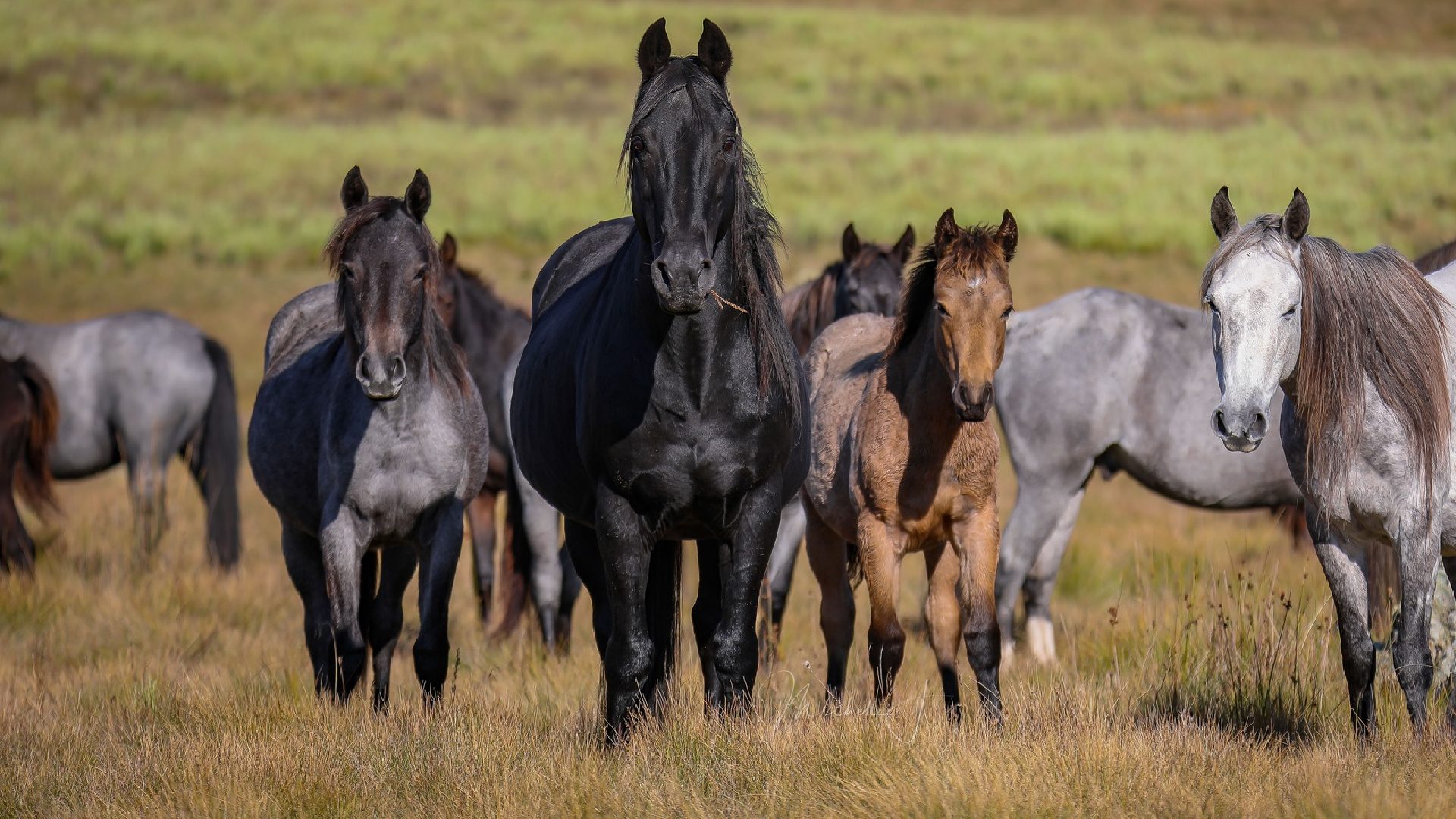
We would like to extend a special thank you to Michelle and Ian Brown of Snowy Brumby Photography Adventures for generously allowing our sister site https://brumbyfacts.org to use their stunning photographs of Brumbies. NOTE: The copyrighted photos are used with their express written consent.
A FALSE BINARY
One of the most effective political tools is the creation of a false choice. Throughout history, complex issues have often been reduced to simple opposites: civilised versus savage, reason versus emotion, science versus compassion.
Critics argue that the Brumby debate has been framed in exactly this way.
Brumby advocates are frequently portrayed as emotional, irrational, anti-science, or opposed to conservation.
Environmental advocates, by contrast, are often presented as rational, scientific, objective, and willing to accept difficult decisions for the greater good.
Reality is rarely that simple.
Advocates behind https://brumbyfacts.org reject the suggestion that compassion for horses is somehow incompatible with environmental stewardship.
Likewise, many environmental advocates care deeply about animal welfare and support protecting native ecosystems without unnecessary suffering.
The real question is not whether Australians care about horses or native wildlife. It is whether governments have adequately explored alternatives before resorting to one of the most controversial wildlife management practices in the country.
We argue that options such as fertility control, strategic rehoming, improved population management, and greater collaboration with regional communities deserve far greater consideration than they have received to date.
Ultimately, the debate is about far more than horses. It is about transparency, evidence-based policy, humane treatment of animals, responsible environmental management, and whether governments should be held accountable when highly visible environmental campaigns appear to distract from larger, more difficult problems. Those are questions every Australian – especially those in NSW – should be asking
The table below outlines how the binary has been framed by aerial shooting proponents that belittle the outrage of Brumby advocates.
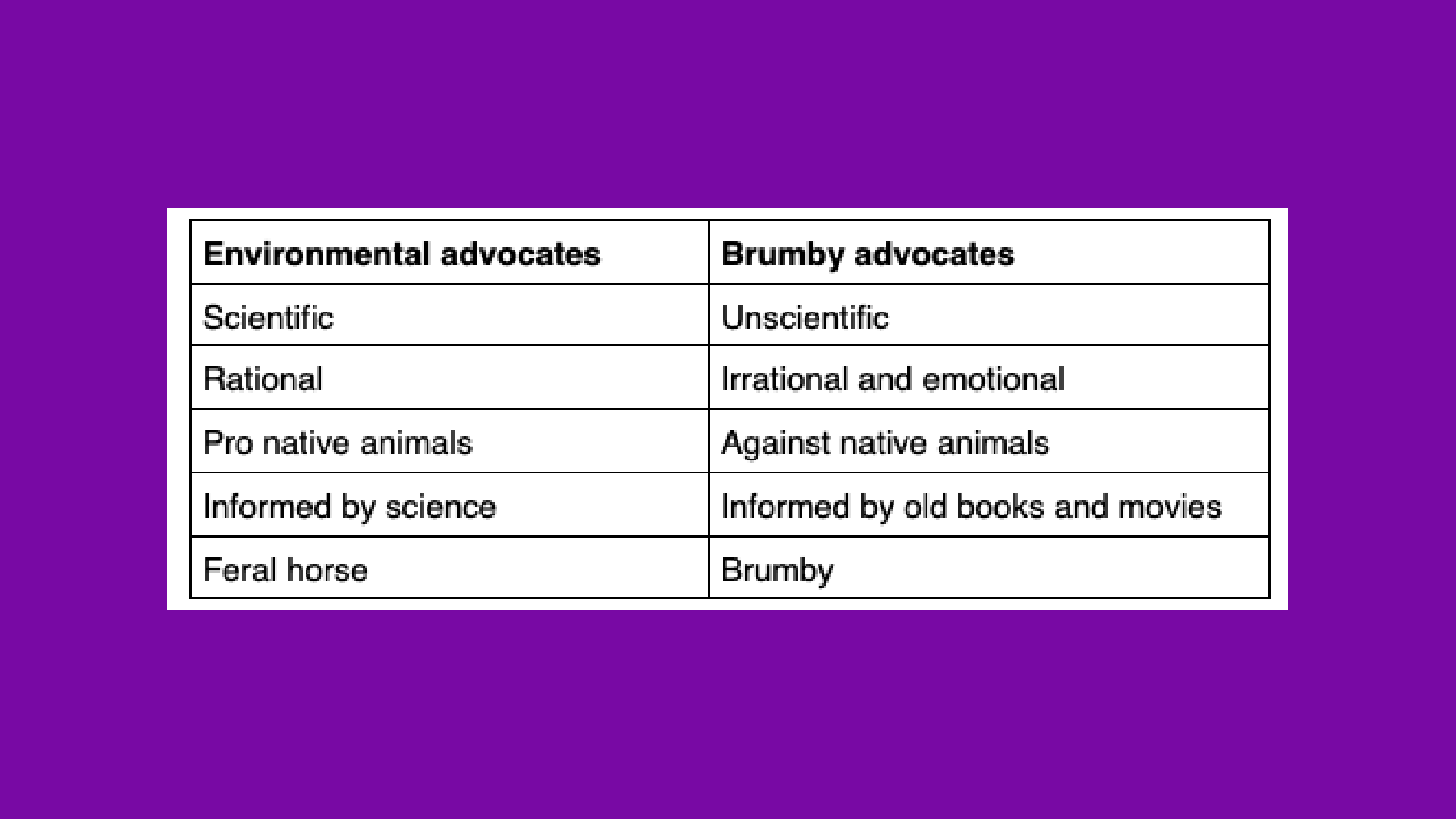
Is this binary gendered?
Does this political strategy use antiquated archetypes reflecting gender roles?
NUMBERS
In the October 2023 population survey, (HLT-DS), the NPWS (National Parks and Wildlife Service) said an estimated 12,934 to 22,536 wild horses inhabit the park.
The difference of almost 10,000 between 12,934 and 22,536 is laughable – having such a wide range totally undermines the numbers and makes the research useless.
“Here the Minister is basing all her decisions on a distance sampling method she has, in the past, viewed with great scepticism… If she ignores this data, she will demonstrate her actions are based on ideology, not science.” Wes Fang, NSW Nationals MLC
An independent count by Claire Galea and Rocky Harvey found a glaring discrepancy in the numbers. Their Air Photo Survey, (February – April 2024) although restricted to a smaller area, only found 569 horses.
Is Penny Sharpe using flawed numbers to engineer a political stunt?
Aerial Shooting proponents have been subjected to a binary that conveys half-truths that denies science, rationality and reason as well as empathy and compassion informs the pro-Brumby argument.
QUESTIONS
Many people who advocate for the environment need to ask difficult questions about the Kosciuszko National Park:
- Why is the Department of Primary Industries and Regional Development still stocking the rivers with trout when they are regarded as the primary predator of native Galaxia fish?
- What are the main threats to the Corroboree Frog?
- How does leaving dead horses around during a pig plague help the environment?
- Is pig damage portrayed as Brumby damage?
- Is Brumby damage equivalent to blasting 40KM of tunnels for Snowy 2.0 in the pristine Alpine environment?
- Do nefarious connections exist between Penny Sharpe and the Invasive Species Council (ISC) that skew information, favour special interests, and undermine democratic processes and public trust?
Has the Invasive Species Council inflamed the issue by providing political noise and exploiting people acting in good faith for the environment?
POLITICAL NOISE
Has Penny Sharpe accrued political capital by exploiting division between Brumby advocates and environmental advocates to amplify political noise?
People are passionate about the environment. Such passion has created a fertile climate for the Penny Sharpe cruel aerial shooting strategy.
Hence, people believe that Brumbies are a threat to the environment and Penny Sharpe is the saviour by her inhumane strategy of slaughtering Brumbies.
Is the controversy about cruel Brumby slaughter designed to obscure other environmental issues? Is Brumby slaughter being used as a smokescreen or Dead Cat Strategy?
Many Brumby advocates claim that the political system has been an exercise in tokenism, where Brumby slaughter was a foregone conclusion, and the various mechanics of the political system have been used to dominate an opponent. It frequently involves hidden agendas, logical fallacies, or a refusal to accept that others have legitimate intentions and arguments. We ask…
IS THAT GOOD FAITH?
What do YOU think?
Join the conversation on our Facebook page at: https://www.facebook.com/@NoAussieHorseSlaughter

#MOHM THREATENED?
We’ve been threatened by those in the horse racing industry and those who benefit from horse slaughter more times than we can count.
But we are not going away.
We are going to persist until horse slaughter no longer exists for any purpose within Australia -- and until the horse racing industry makes drastic changes.
We are going to continue our hands-on work to offer lifelong sanctuary to as many horses as possible. We generally have 20 at just one of our locations - at any given time.
We have the acreage to take on more horses as financial support allows.

VLANDYS VERSUS LEONARD
WHEN RACING'S P.R. WORLD STARTS EATING ITSELFVicky Leonard — a public relations professional who has built a business around promoting and monetising pro-racing initiatives — has publicly confirmed she has received a formal legal letter (commonly referred to as a...
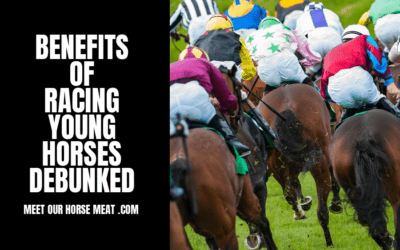
RACING YOUNG HORSES IS NOT GOOD
WHAT SCIENCE & EVERY OTHER HORSE SPORT TELLS US...The racing industry insists that starting horses young — and racing them at two years old — is not only harmless, but beneficial. According to this narrative, early racing “strengthens bones,” prepares horses for...

Join us on social media and become a keyboard warrior.