

MEET OUR HORSE MEAT
LEARN ABOUT THE GREEDY HORSE-KILLING TRADE FOR HUMAN & PET CONSUMPTION & HOW YOU CAN HELP HORSES ESCAPE THIS VICIOUS FATE DONATE“WASTAGE”: THE HORSERACING INDUSTRY’S WORD FOR LIVING, BREATHING HORSES (YES, REALLY!)
In 2019, I was shocked and horrified the first time I heard that the racing industry in Australia refers to some horses as ‘wastage.’
How can anyone justify calling a living being ‘waste’?
How easily language hides cruelty.
It’s a gut punch of truth — a glimpse into how normalized harm becomes when we stop questioning the words we use.
In 2025, I’m less shocked — and somehow even more horrified. Not because the horse racing industry has changed, but because I’ve come to expect the worst.
The more I learn, the less surprised I am — and the more deeply it disturbs me.
“WASTAGE”: WHEN THE HORSERACING INDUSTRY REDUCES LIVES TO PROFIT LOSSES
Think about that for a moment — a sentient being reduced to a word that belongs in a rubbish bin.
“Wastage” in horseracing refers to the horses who:
– Don’t win or earn enough money
– Are injured and can no longer race
– Never make it to the track at all
– Are retired early or …
– Discarded when no longer useful
Behind this cold term are living, feeling beings — animals who experience pain, fear, joy, and affection.
Calling horses “wastage” makes it easier to justify their suffering and….
Justify their slaughter if they are not generating a profit.
MANY OWNERS & TRAINERS INSTRUCT DOGGERS TO KILL HORSES,
THAT THEY ARE NOT TO BE REHOMED
Once their racing days are over, many of these horses disappear.
Some end up at sale yards, others go directly to slaughterhouses AKA knackeries and abattoirs — and, disturbingly, many are sent to slaughter on the direct instruction of their owners and trainers.
In July 2018, on the ABC Four Corners program Off Track, Dr. Bidda Jones, Chief Scientist of RSPCA Australia, revealed that 8,500 horses exit the thoroughbred racing industry every year.
Many of them, Jones said, have nowhere to go.
We know that countless trainers send these horses straight to doggers — the slaughter buyers. Some even explicitly instruct the dogger to kill the horse and that they are not to be rehomed.
That is what “wastage” looks like in practice.
THE HORSE RACING INDUSTRY’S DISPOSABLE ATTITUDE TOWARDS HORSES

Thoroughbred horse trainer Gai Waterhouse, one of Australian racing’s most celebrated figures, made headlines in March 2023 when she brushed off horse deaths by saying, “Accidents happen in any sport.”
She went on to claim that “people have become so weak and prissy nowadays.”
Around that same time, two horses died on the track — Florescent Star (March 18, 2023) and Temple of Artemis (March 29, 2023).
Just weeks later, on April 24, 2023, a jockey also died.
Not to diminish the tragedy of jockey deaths, but there’s a difference:
Human athletes have a choice. Horses do not.
Horses don’t volunteer to train, compete, or risk their lives for someone’s bet slip.
They don’t choose to race through pain or exhaustion — they are made to.
And when their careers end or their bodies fail, they are branded as “wastage” and quietly discarded.
In April 2023, Waterhouse doubled down, calling racing critics “woke,” “on the dole,” and “ill-informed.”
She insisted the horse racing industry needs to “fight back” against activists rather than face the truth about how it treats horses.
If caring about horses — about the thousands bred, broken, and destroyed every year — makes us “weak and prissy,” then so be it.
We’ll proudly wear those labels if it means standing up for the voiceless.
THE NUMBERS BEHIND THE CRUELTY
Australia has more race tracks than any other country in the world, and the industry must fill race fields every day across eight states.
That relentless demand drives an endless breeding cycle — one that guarantees a constant flow of replacements for those discarded.
A 2010 study published in Sydney examined 146,046 thoroughbred horses over 10 years.
Although horses naturally live 25–30 years, the median racing career lasted just 14.7 months — about 4.9% of their lifespan, with an average of only 10 starts.
They are bred knowing that only a tiny fraction of their lives will be spent racing — and then they are expected to be off-loaded to the public or slaughtered when no longer profitable.
The study also found that the rate of attrition — the “wastage” — was directly linked to the animals’ well-being within the industry.
Horses have no agency. No choice.
THE BUSINESS MODEL – GAMBLING & EXPLOITATION
The horse racing industry survives on gambling — a dangerous, addictive product that destroys families and communities while exploiting animals for profit.
After winnings are paid out to punters, state governments and racing bodies make their profits from gamblers’ losses.
Gambling is not a side effect of racing — it is the business model.
41% of all regular racing gamblers (around 403,000 adults) experience gambling-related harm.
During the 2019/2020 racing season, there were 34,337 horses actively racing across eight states.
Each year, thousands vanish — labelled “wastage” and erased from public view.
These horses are the collateral damage of a system built on exploitation — of both people and animals.
THE RACING INDUSTRY NEEDS TO DO BETTER
Horses are not wastage.
Referring to them as such – and treating them as the same is a betrayal.
To end “wastage,” the racing industry must change the system — and the language that sustains it.
The racing industry must reject the term “wastage.”
Demand full traceability for every racehorse, from birth to end of life.
Expose and condemn trainers and owners who send horses to slaughter or forbid rehoming.
Support rehoming programs and sanctuaries.
Join us and help advocate for legislation that protects horses beyond their racing careers.
Because horses are not “wastage.”
They are living beings deserving of so much better.
RACEHORSE TESTS POSITIVE FOR COCAINE
HORSERACING IS NOT A SPORTWe've said it before and we'll say it again, horse racing is not a sport. Sport implies that all participants are willing - and do so by their own free will. Horses do NOT have a choice in the matter. Horse racing is a spectacle of abuse -...

COGNITIVE DISSONANCE
First, let's be clear about what "cognitive dissonance" is. The simplest way to define it is... Cognitive dissonance is a mental conflict that occurs when your beliefs don’t line up with your actions. Psychiatrist Grant H. Brenner MD, FAPA, co-founder of Neighborhood...
DOGGERS
AN OPEN LETTER TO THOSE DEFENDING DOGGERSThis is directed at those who defend "doggers". But first, there may be those who don't know what a dogger is. In Australia, a person who collects, buys or is given horses and takes them to slaughter is known as a dogger....
BARBARIC TONGUE TIE PROUDLY DISPLAYED
EVEN HORSE RACING FANS HORRIFIED AT CHOICE OF PICTUREDOES THIS HORSE LOOK COMFORTABLE TO YOU?Recently we were shocked to see the picture below published in a wide variety of publications in Australia INCLUDING but not limited to... NEWS.com.au | Herald Sun and on a...
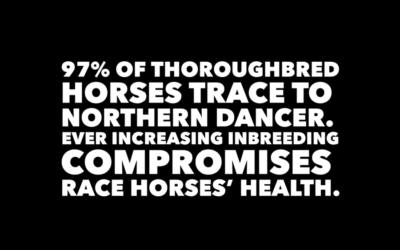
INBREEDING RAMPANT IN THOROUGHBRED LINES
HORSE RACING INDUSTRY "RACING POST" PUBLISHES STUDY RESULTSWe recently tweeted:One of the responses was a tweet from Sandy Bayley whose profile states: Fair horse racing advocate. Anti desperadoes who hurt horses with drugs.Meet Our Horse Meat writes: Recently...
BELOVED HORSE TORTURED
JOCKEY SAYS SHE FAILEDABCNEWS.AU.NET“I truly hope you break your f***ing neck.”That’s one of dozens of hateful messages sent to Gold Coast jockey Laura Cheshire after the 35-year-old’s former champion racehorse was tortured and slaughtered at the hands of abattoir...
HORSE TRAINER DARREN WEIR PLEADS GUILTY AGAIN
MULTIPLE CHARGES AGAINST DARREN WEIR & GUILTY PLEASLet's start with a little history about horse trainer Darren Weir -- courtesy of RACENET. It includes everything from using banned and abusive "jiggers" on horses, to falsely identifying horses, to having horses...
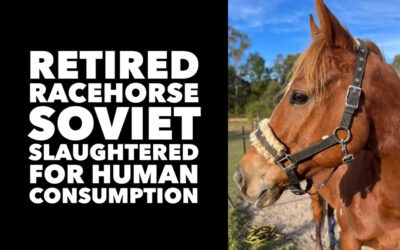
SOVIET
$270,000 HORSE SLAUGHTERED FOR HUMAN CONSUMPTIONSoviet was killed at #Meramist last Monday, June 27, 2022, for human consumption. He ended up with what we call 'doggers' - a person that buys a horse for slaughter, and who in some cases will on-sell for more money. ...
SCHOOLS KEEPING HORSE RACING OUT
A SMALL VICTORY FOR THOSE WORKING TO BOYCOTT HORSE RACINGDo you ever wonder if boycotting racing, sharing social media posts and engaging others in conversations about horseracing is working? Is it helping to educate others about the wrongdoings in the horse racing...