
WHO IS THE RACING INDUSTRY KIDDING?
We’ve asked that question before and we are asking it again. “Who is the racing industry kidding?”.
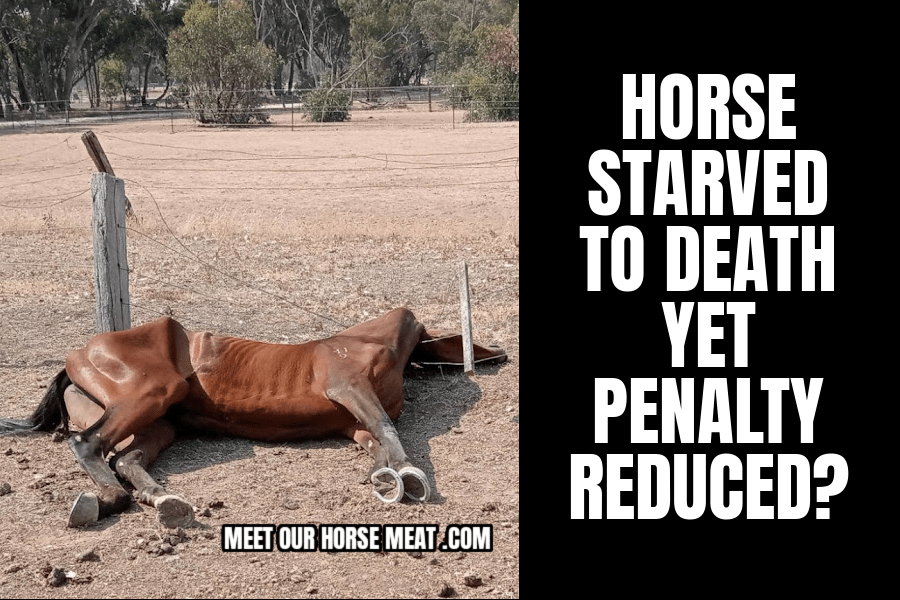
A racehorse named City Limits is dead.
The horse was found in an emaciated condition after spending months in a paddock near Maryborough, Victoria.
Racing authorities concluded that trainer Brian Carey had failed to ensure the horse received adequate food and water.
The penalty was a 16-month disqualification.
Then the decision was appealed.
The finding itself did not change. The horse was still dead. The welfare breach was still proven. Yet the penalty was reduced from 16 months to 13 months.
For many Australians, that raises a simple question.
Why?
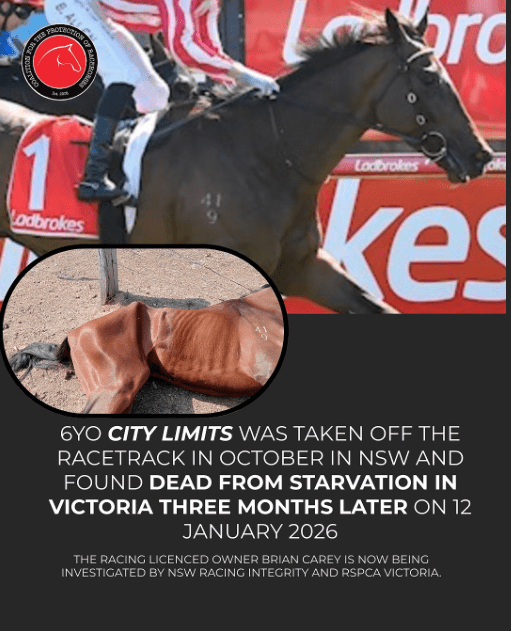
According to reports from the appeal proceedings, Carey had not personally checked on the horse for approximately 74 days.
Evidence indicated that the paddock contained little or no feed, the water trough was dry, and warning signs had been missed or ignored.
The Appeal Panel also found that false information had been provided to an investigator regarding how often the horse had been checked.
None of those findings were overturned.
The horse did not somehow become less dead.
The neglect did not somehow become less serious.
The suffering did not somehow become less real.
And yet the penalty was reduced? Yes, really!
The Appeal Panel reportedly considered factors such as a guilty plea, an admission of responsibility, personal circumstances, and the absence of an intention to harm the horse.
But that explanation may leave many members of the public scratching their heads.
Because while there may not have been an intention to cause suffering, the outcome remains exactly the same.
A horse starved to death.
Imagine explaining this situation to someone who has never followed horse racing.
Imagine telling them that a licensed racing participant was found responsible for failing to provide adequate food and water to a horse.
Imagine telling them that the horse ultimately died in an emaciated condition.
Then imagine telling them that the participant received a ban of just over a year.
Would they consider that a serious consequence?
Or would they wonder whether the racing industry operates under a very different standard of accountability than the rest of society?
That question goes well beyond Brian Carey.
It speaks to a much larger issue within horse racing.
The industry regularly assures the public that horse welfare is its highest priority.
Racing organizations spend millions promoting the idea that horses come first. Welfare initiatives are advertised. Welfare commitments are published. Welfare promises are repeated.
But the true test of any industry’s commitment to welfare is not what it says when things are going well.
It is what happens when things go terribly wrong.
When a horse dies from neglect, what consequences follow?
What message is sent?
What standard is being set for everyone else in the industry?
Cases like this matter because they shape public trust.
Many people can accept that accidents happen. They can accept that horses, like humans, become ill or injured. They can accept that not every tragedy is preventable.
What is much harder to accept is the idea that a horse could allegedly go unchecked for weeks, be left without adequate food and water, die in an emaciated condition, and still leave the public debating whether the penalty was harsh enough.
HORSE RACING IS SELF-REGULATED…
The racing industry often complains that it is losing its social licence.
Perhaps it should spend more time asking why.
Every time a welfare scandal emerges, the public is asked to believe that it is an isolated incident. Every time a horse suffers, the public is assured that welfare remains the industry’s highest priority.
Yet when penalties appear disconnected from outcomes, those assurances become harder to believe.
The uncomfortable reality is that many Australians will look at this case and reach a simple conclusion.
If a horse starving to death results in a 13-month disqualification, what exactly would justify a lifetime ban?
It is a question the racing industry may not want to answer.
But it is one that more and more people are asking.
THAT SHOULD HORRIFY PEOPLE
If you genuinely care about horses, the most powerful thing you can do is stop supporting the industry that profits from their suffering.
Do not attend races.
Do not bet on races.
Do not watch racing “for entertainment.”
Do not normalize exploitation as sport.
Because every dollar, every ticket, and every viewing number helps keep this system alive.
Horses deserve better than a lifetime of fear, confinement, violence, and exploitation disguised as entertainment.
IF YOU CARE ABOUT HORSES – SPEAK UP
Help us raise awareness.
Boycott horse racing – including saying #nuptothecup.
Please support our work if you can.
What do YOU think?
Join the conversation on our Facebook page at: https://www.facebook.com/@NoAussieHorseSlaughter
#MOHM THREATENED?
We’ve been threatened by those in the horse racing industry and those who benefit from horse slaughter more times than we can count.
But we are not going away.
We are going to persist until horse slaughter no longer exists for any purpose within Australia -- and until the horse racing industry makes drastic changes.
We are going to continue our hands-on work to offer lifelong sanctuary to as many horses as possible. We generally have 20 at just one of our locations - at any given time.
We have the acreage to take on more horses as financial support allows.

HORSE RACING DEATH WATCH 2025
CPR DEATHWATCH REPORT 2024The Deathwatch report, meticulously compiled each year by the Coalition for the Protection of Racehorses (CPR), shines a stark light on the tragedies inherent in horse racing. While the racing industry often cites statistics to highlight...
HORSE SLAUGHTER IS NOT NECESSARY
WHAT HAPPENS TO "UNWANTED" HORSES IF SLAUGHTER ENDS? CONTENT WARNING: The videos below include extremely graphic and disturbing footage of horse slaughter. They are confronting by design. Meet Our Horse Meat exists to show what the racing industry and its defenders...

Join us on social media and become a keyboard warrior.