
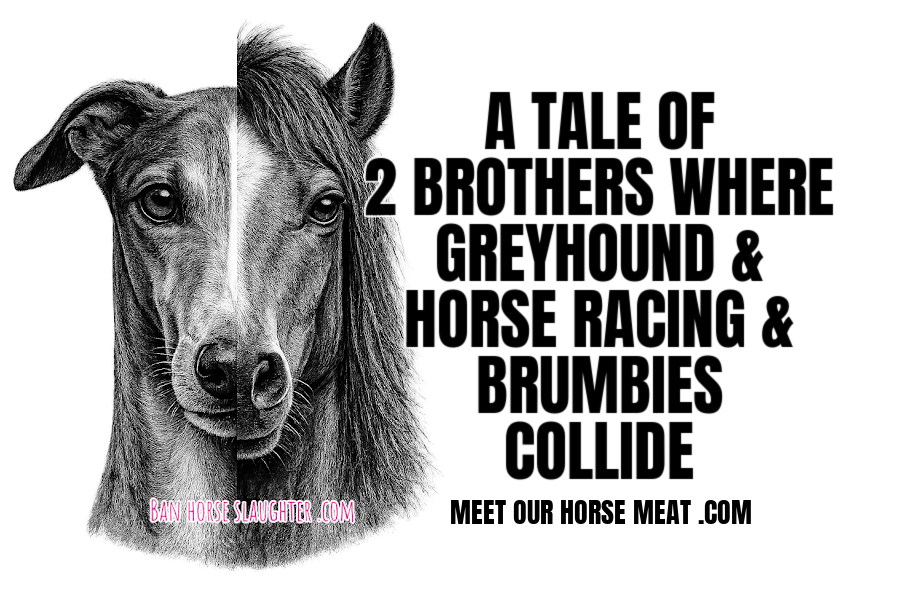
WHEN RACING WORLDS COLLIDE: BRUMBIES & RACEHORSES (& GREYHOUNDS) SUFFER
Greyhound racing has become a major animal welfare issue in Australia, and though it is often treated as separate from horse racing and the horse-meat trade, the horse slaughter, horse racing and greyhound racing industries share structural similarities rooted in exploitation for entertainment, gambling, and profit.
Sometimes, those similarities are not just theoretical.
THE TALE OF THE TALBOT BROTHERS
In New South Wales, one case has drawn attention to how poor oversight, fragmented regulation, and industry silos can allow animals to disappear — and serious questions to go unanswered.
The case involves two brothers operating in adjacent worlds of the racing economy.
Adrian Talbot, associated with an alleged illegal knackery and the slaughter of horses promoted as part of a “rehoming” program.
Ben Talbot, a long-time figure in greyhound racing administration and leadership.
This is not a story about guilt by association.
It is a story about systems that allow overlap without scrutiny.

ADRIAN TALBOT RE-HOMER OF BRUMBIES, RACEHORSES & PETS?
Adrian Talbot publicly claimed to be operating a brumby rehoming program.
Horses — including brumbies, racehorses and pet horses — were sought after and presented as – being rescued, rehabilitated, and re-homed.
Instead, authorities later uncovered hundreds of butchered horse carcasses, leading to the shutdown of an illegal knackery operation and environmental charges related to dumping remains.
Investigations documented by Brumby Facts revealed that:
the operation was not licensed,
carcasses were improperly disposed of,
and horses believed to be destined for rehoming were allegedly slaughtered.
Further public reporting showed that Adrian Talbot had previously been barred from participation in an off-the-track thoroughbred (OTTB) rehoming program, raising additional concerns about how “rehoming” claims were being used — and misused.
The case highlighted how easily rehoming narratives can function as cover in the absence of enforceable tracking and oversight – ESPECIALLY when money can be raked in by selling horsemeat to, for example, the greyhound racing industry.
BEN TALBOT & GREYHOUND RACING
At the same time, Adrian Talbot’s brother, Ben Talbot, was operating in a different — but connected — space.
Ben Talbot has been publicly identified as:
a senior figure associated with the Wagga Wagga Greyhound Club, (see the video above)
a long-time participant in greyhound racing administration, and
a member of advisory structures connected to greyhound racing governance in New South Wales.
The Wagga Wagga track, while reportedly profitable, has since been slated for closure as part of broader industry restructuring and “track optimisation” efforts — reflecting the declining social licence of greyhound racing more broadly.
THE QUESTION THE SYSTEM HAS US ASKING…
Horse meat is legally used in Australia as feed for racing greyhounds.
It is commonly supplied to greyhound owners and trainers and, in some cases, delivered directly to racing facilities or training tracks.
Against that backdrop, the existence of an illegal knackery producing cheap horse meat, operating at the same time a close family member was embedded in greyhound racing administration, raised a question that regulators and the public are entitled to ask:
Was horse meat from an illegal operation entering the greyhound racing supply chain?
No allegation is made here.
No conclusion is asserted.
But the question exists because the system allows it to exist.
THIS IS NOT JUST ABOUT ONE FAMILY
This story matters not because of who the Talbots are — but because of what their cases reveal.
Australia currently lacks:
a national, enforceable lifetime tracking system for horses,
meaningful oversight of “rehoming” claims,
transparent supply-chain auditing for horse meat used in racing industries,
and clear separation between industry governance and commercial interests.
When animals fall out of racing systems, they often fall out of visibility.
Greyhounds who fail to perform are considered surplus can vanish from public accounting.
Racehorses are often referred to as ‘wastage‘ and can disappear into slaughter pipelines.
Brumbies presented as “saved” can end up butchered.
Different animals.
Different industries.
Same outcome.
Until transparency, traceability, lifelong accountability and independent oversight are enforced across the horse and greyhound racing industries, these questions will continue to arise — and animals will continue to pay the price.

You don’t need to be an expert to make a difference — you just need to speak up.
We are providing a done for you copy and paste letter – plus how to contact the right decision-makers and ask for meaningful improvements to greyhound racing regulations.
If this work matters to you, please consider donating. Behind the scenes, we are caring for 20 rescued horses at one sanctuary alone, every day, while working to prevent more animals from being failed by the same systems.
What do YOU think?
Join the conversation on our Facebook page at: https://www.facebook.com/@NoAussieHorseSlaughter
#MOHM THREATENED?
We’ve been threatened by those in the horse racing industry and those who benefit from horse slaughter more times than we can count.
But we are not going away.
We are going to persist until horse slaughter no longer exists for any purpose within Australia -- and until the horse racing industry makes drastic changes.
We are going to continue our hands-on work to offer lifelong sanctuary to as many horses as possible. We generally have 20 at just one of our locations - at any given time.
We have the acreage to take on more horses as financial support allows.

BRUMBY SPECIFIC WEBSITE
#MOHM HAS A BRUMBY SPECIFIC WEBSITE TOOAs you know we are dedicated to banning the slaughter of horses in Australia for any purpose and that includes wild horses. Please join us on our "sister" website dedicated to banning the slaughter of wild horses AKA Brumbies for...
PUSH BUTTON DONE-FOR-YOU EMAIL
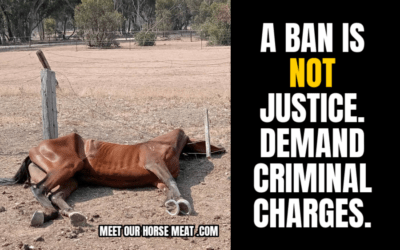
DEMAND CRIMINAL CHARGES - NOW!Horses died, the racing industry issued a ban. Is that justice? The death of City Limits shows us that the racing industry should NOT be regulating themselves.In January 2026, neighbours discovered the five-year-old thoroughbred City...

CURRENT PETITIONS
WE TAKE SOME PETITIONS SERIOUSLYAt Meet Our Horse Meat, we take 'some' petitions seriously—because we know not all petitions are created equal. That’s why we generally do not promote petitions that are privately hosted or lack government backing. Instead, we focus on...

Join us on social media and become a keyboard warrior.