
WHEN PROFIT DRIVES BREEDING HORSES PAY THE PRICE
From an animal welfare and sentience perspective, the following research argues that broodmares are often treated less as individual animals and more as reproductive commodities whose value is tied to their ability to produce profitable foals.
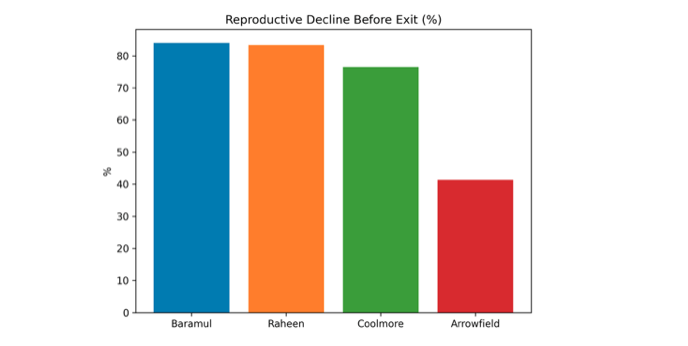
By examining records from the 2016 Magic Millions sale alongside Australian Stud Book data, the research identified patterns of reproductive decline in many mares before they exited breeding programs, including failed pregnancies, foal losses, fertility issues, and repeated breeding attempts.
The findings also raise ethical concerns about what happens to mares once they are no longer commercially useful. Younger mares in foal may continue to hold market value, but older mares are frequently “passed in” at auction, meaning buyers are unwilling to meet even the reserve price.
The research challenges the industry narrative that Thoroughbreds are broadly rehomed after their racing or breeding careers end.
While some certainly are, the lack of transparency surrounding older broodmares and commercially unviable horses leaves significant uncertainty about their eventual outcomes.
It also questions the ethics of intensive breeding practices and the heavy reliance on fashionable bloodlines such as Danehill. Critics argue that prioritizing commercial desirability over genetic diversity may contribute to fertility problems, health issues, and reduced long-term wellbeing within the breed.
Ultimately, the following research asks whether an industry built around profit and production can adequately protect the welfare, dignity, and lifelong care of the animals on which it depends.
OVERVIEW
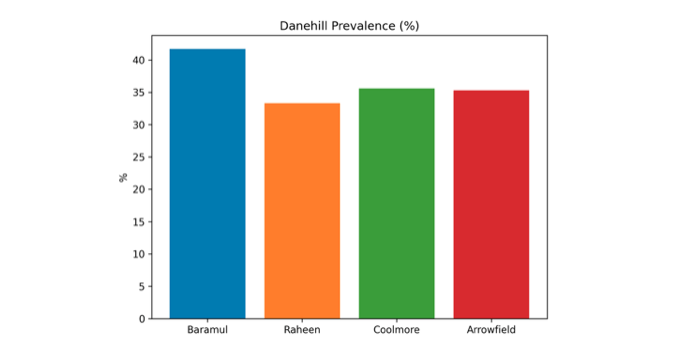
This analysis examined broodmares listed as the dams of yearlings sold at the 2016 Magic Millions sale, cross-referencing them with Australian Stud Book records. The research focused on the prevalence of Danehill bloodlines, deceased foals after birth, reproductive decline prior to mares leaving breeding programs, and overall lifetime foal production.
DANEHILL & INBREEDING
Danehill became one of the most commercially influential stallions in Australian Thoroughbred breeding after arriving as a shuttle stallion in 1990. Today, his bloodline is deeply embedded throughout the breed population.
According to research by geneticist Emmeline Hill, approximately 55% of Australian Thoroughbreds carry Danehill bloodlines. Critics argue that the industry’s heavy reliance on a small number of fashionable stallions has contributed to increasing levels of inbreeding and reduced genetic diversity within the breed.
From an animal welfare perspective, concerns have been raised that narrowing the gene pool may be associated with declining fertility, reduced durability, increased health vulnerabilities, and the spread of harmful genetic traits. In response, some studs are now actively promoting “outcross” or Danehill-free stallions in an effort to diversify bloodlines.
DECEASED FOALS (AFTER BIRTH)
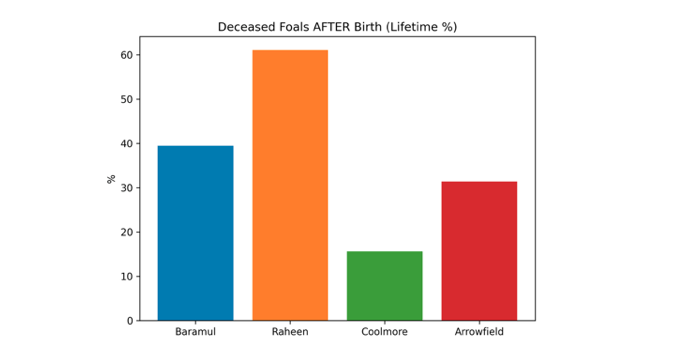
Baramul 39.5% | Raheen 61.1% | Arrowfield 31.4% | Coolmore 15.6%. This measures foals that died AFTER birth across the mare’s lifetime.
FOAL PRODUCTION (AVERAGE VERSUS MEDIAN)
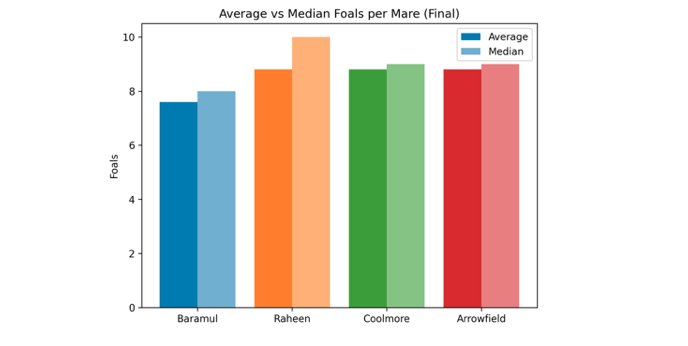
Median represents the typical mare, while averages are influenced by high-producing mares. Typical broodmares produce approximately 8–10 foals across their lifetime.
AGE AT EXIT
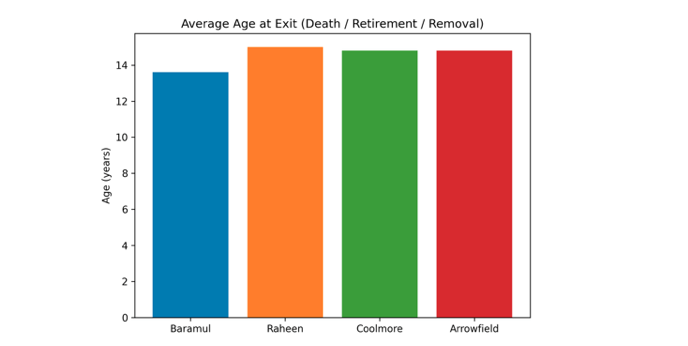
Approximate age at which mares leave active breeding (death, retirement or removal).
INDUSTRY OBSERVATIONS
Visits to Hunter Valley breeding farms revealed conflicting explanations about the fate of broodmares once their breeding careers end.
One claim suggested mares commonly die around the age of 16 due to laminitis caused by prolonged standing, while other industry representatives insisted many mares live into their 20s.
The lack of consistent answers raises broader questions about transparency within the breeding industry.
The racing industry frequently promotes the idea that Thoroughbreds are rehomed after racing. While some certainly are, more than 8,000 horses leave racing each year, and many mares transition into breeding because they still retain commercial value through producing foals.
However, there appears to be far less focus on what happens once that value declines. As mentioned in our opening paragraphs younger mares in foal are generally easier to sell, while older mares are often “passed in” at auction — meaning buyers are unwilling to meet even the reserve price.
From an animal welfare perspective, this raises difficult and uncomfortable questions about the long-term outcomes for broodmares once they are no longer profitable.
For those who bet on racing, attend race meetings, or simply watch the sport on television, this is also part of the industry being financially supported: a breeding system where an animal’s value is closely tied to its reproductive and commercial usefulness.
IF YOU CARE ABOUT HORSES – SPEAK UP
Help us raise awareness.
Boycott horse racing – including saying #nuptothecup.
Please support our work if you can.
What do YOU think?
Join the conversation on our Facebook page at: https://www.facebook.com/@NoAussieHorseSlaughter
#MOHM THREATENED?
We’ve been threatened by those in the horse racing industry and those who benefit from horse slaughter more times than we can count.
But we are not going away.
We are going to persist until horse slaughter no longer exists for any purpose within Australia -- and until the horse racing industry makes drastic changes.
We are going to continue our hands-on work to offer lifelong sanctuary to as many horses as possible. We generally have 20 at just one of our locations - at any given time.
We have the acreage to take on more horses as financial support allows.

BRUMBY SPECIFIC WEBSITE
#MOHM HAS A BRUMBY SPECIFIC WEBSITE TOOAs you know we are dedicated to banning the slaughter of horses in Australia for any purpose and that includes wild horses. Please join us on our "sister" website dedicated to banning the slaughter of wild horses AKA Brumbies for...
ADRIAN TALBOT GUILTY & FINED
HORSE MEAT, BRUMBIES, GREYHOUND RACING & THE QUESTIONS THAT REMAINIn January, we published Talbot Brothers: When Racing Worlds Collide — Brumbies, Racehorses & Greyhounds Suffer, examining the disturbing connections between horse rehoming, the horse-meat trade...
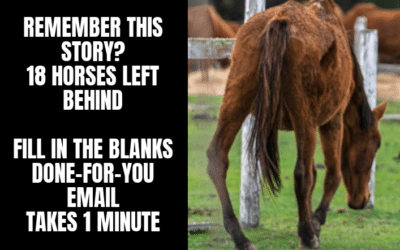
MAXINE FRASER MOUNT ELIZA VICTORIA
DEMAND RSPCA CHARGE MAXINE FRASERPHOTO CREDIT CAROL AUGUSTINUSWe have been following the Maxine Fraser case for years. Our reporting in July 2025 documented the long history of concerns surrounding Fraser's Mount Eliza property, including Racing Victoria inspections...

Join us on social media and become a keyboard warrior.