
WHO IS THE RACING INDUSTRY KIDDING?
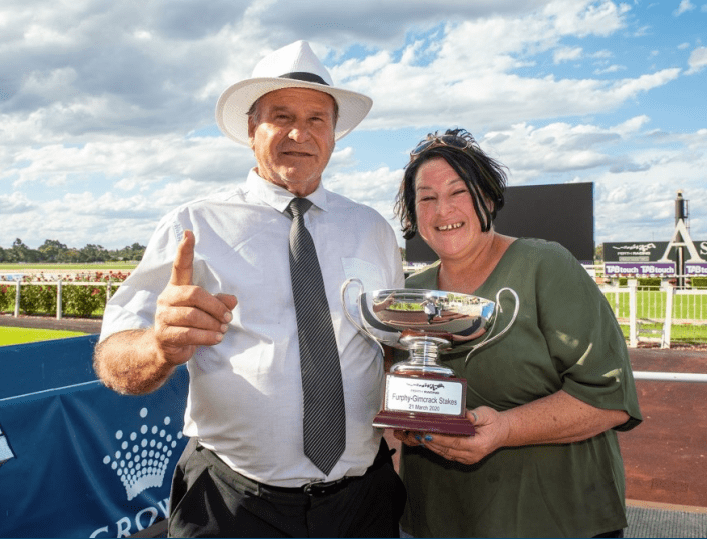
Photo above via Facebook — Ascot Racecourse following the Furphy-Gimcrack Stakes.
The racing industry wants the public to believe incidents like this are rare, unacceptable and out of character.
But who are they trying to kid?
This week, Western Australian trainer, horse breeder/owner Mike Santich was suspended after allegedly punching four-year-old racehorse Angels Impact in the face twice and kicking him twice in the stomach during trackwork at Ascot.
This did NOT happen in secret, it was not hidden away, it wasn’t in some isolated location where no-one would see.
This allegedly happened openly, at a racetrack, around other racing participants, during ordinary industry operations.
And that should concern the public far more than the racing industry appears willing to acknowledge.
Because this was not the behaviour of someone acting as though what they were doing was shocking or unimaginable. It was behaviour carried out by someone who seemingly did not expect serious consequences for treating a horse this way.
If a trainer feels comfortable punching and kicking a horse where others may witness it, what happens behind closed stable doors when nobody else is around?
That is the question people should be asking.
According to follow-up reporting, Mr Santich reportedly plans to appeal what he described as an “unbelievable” five-month suspension, suggesting there is little genuine understanding of the seriousness of what allegedly occurred.
Reports also state that Angels Impact allegedly bit Mr Santich when approached inside his stall and then pressed himself against the back wall while Mr Santich attempted to remove his rug before saddling him.
Anyone familiar with horses should recognise that behaviour as significant.
A horse confined in a stall would ordinarily be eager to come out. So why was Angels Impact trying so hard to avoid contact?
Instead of calming the horse, reassuring him, or simply walking away, the response was violence.
Two punches to the face.
Two kicks to the stomach.
And this was done to a horse who has reportedly earned more than $150,000 for his human connections.
THE REALITY OF THE HORSE RACING INDUSTRY
Horses are treated as valuable while they are profitable, yet their emotional and physical wellbeing remains secondary to performance, obedience, and financial return.
What is perhaps most revealing is not only the violence itself, but the response from the industry responsible for regulating it.
In handing down the penalty, Racing WA reportedly considered Mr Santich’s otherwise clean record, his lengthy time in the industry, and the fact there was “no evidence of physical injury” to the horse.
That sentence alone says everything about racing culture.
A horse can allegedly be punched and kicked by a licensed trainer, yet the conversation quickly shifts toward protecting the reputation and future of the person responsible.
HORSE RACING IS SELF-REGULATED…
This is what self-regulation looks like…
The racing industry investigates the racing industry. The racing industry ‘punishes’ the racing industry with slaps on the wrist.
And then reassures the public that welfare comes first.
Meanwhile, the horse has no voice.
People often ask why anti-racing advocates oppose the entire system rather than focusing only on individual acts of cruelty.
Well, here is why. Because cruelty does not happen in isolation inside racing. It grows from a culture where horses are commodities — bred for profit, pushed for performance, confined, controlled, discarded, and expected to tolerate whatever humans demand from them.
Every scandal is framed as an exception.
Every abuse case is described as rare.
Every death is labelled unfortunate – but to be expected – just part of the industry.
And yet the stories never stop.
THAT SHOULD HORRIFY PEOPLE
If you genuinely care about horses, the most powerful thing you can do is stop supporting the industry that profits from their suffering.
Do not attend races.
Do not bet on races.
Do not watch racing “for entertainment.”
Do not normalize exploitation as sport.
Because every dollar, every ticket, and every viewing number helps keep this system alive.
Horses deserve better than a lifetime of fear, confinement, violence, and exploitation disguised as entertainment.
IF YOU CARE ABOUT HORSES – SPEAK UP
Help us raise awareness.
Boycott horse racing – including saying #nuptothecup.
Please support our work if you can.
What do YOU think?
Join the conversation on our Facebook page at: https://www.facebook.com/@NoAussieHorseSlaughter
#MOHM THREATENED?
We’ve been threatened by those in the horse racing industry and those who benefit from horse slaughter more times than we can count.
But we are not going away.
We are going to persist until horse slaughter no longer exists for any purpose within Australia -- and until the horse racing industry makes drastic changes.
We are going to continue our hands-on work to offer lifelong sanctuary to as many horses as possible. We generally have 20 at just one of our locations - at any given time.
We have the acreage to take on more horses as financial support allows.

BRUMBY SPECIFIC WEBSITE
#MOHM HAS A BRUMBY SPECIFIC WEBSITE TOOAs you know we are dedicated to banning the slaughter of horses in Australia for any purpose and that includes wild horses. Please join us on our "sister" website dedicated to banning the slaughter of wild horses AKA Brumbies for...
ADRIAN TALBOT GUILTY & FINED
HORSE MEAT, BRUMBIES, GREYHOUND RACING & THE QUESTIONS THAT REMAINIn January, we published Talbot Brothers: When Racing Worlds Collide — Brumbies, Racehorses & Greyhounds Suffer, examining the disturbing connections between horse rehoming, the horse-meat trade...
MAXINE FRASER MOUNT ELIZA VICTORIA
DEMAND RSPCA CHARGE MAXINE FRASERPHOTO CREDIT CAROL AUGUSTINUSWe have been following the Maxine Fraser case for years. Our reporting in July 2025 documented the long history of concerns surrounding Fraser's Mount Eliza property, including Racing Victoria inspections...

Join us on social media and become a keyboard warrior.